
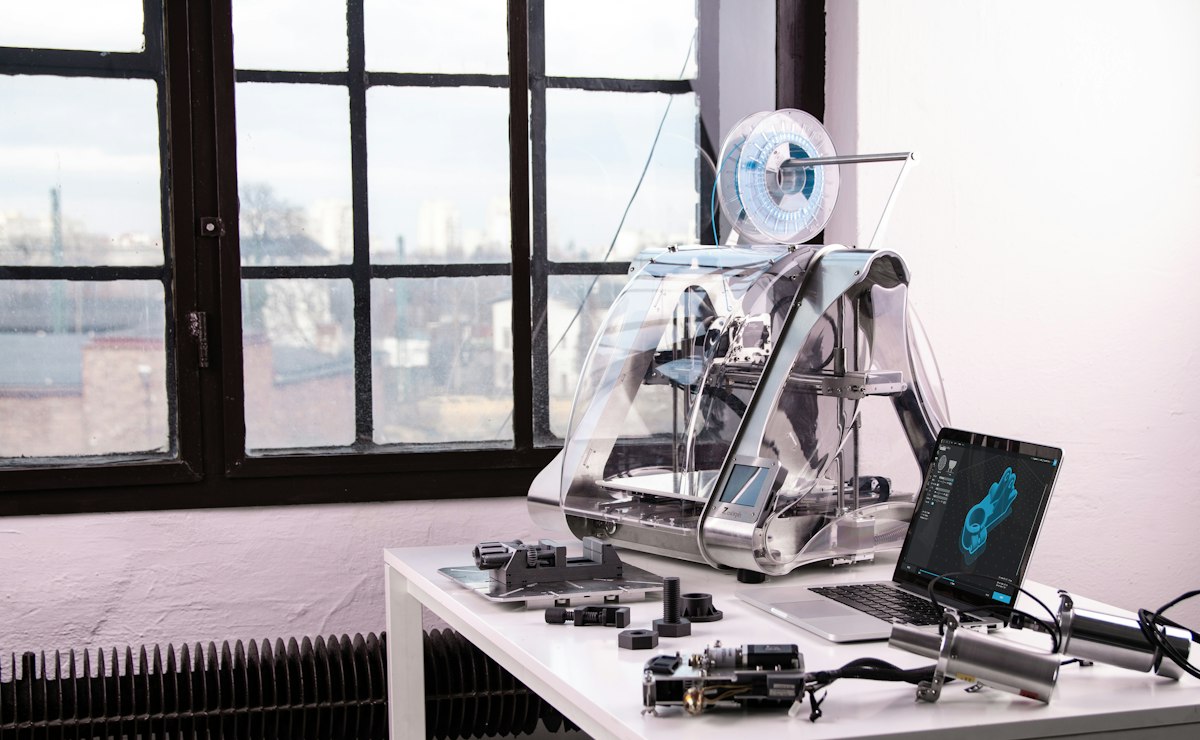
Additive manufacturing, popularly known as 3D food printing, represents the confluence of computational geometry, mechanical engineering, and food polymer rheology. By depositing edible biopolymeric formulations layer-by-layer under digital algorithmic control, 3D printing enables the fabrication of customized internal porosities, personalized micro-nutrient payloads, and tailored chewing textures indispensable for clinical dysphagia diets and alternative protein structuring.
Contents3 sections
1. Introduction: Material Extrusion Physics, Herschel-Bulkley Rheology, and Yield Stress (τ_y)
The dominant technological paradigm in 3D food printing is Direct Material Extrusion (DME). The mechanical feasibility of printing an edible ink relies strictly on non-Newtonian, shear-thinning (pseudoplastic) fluid dynamics described by the Herschel-Bulkley model: τ = τ_y + K · γ̇ⁿ, where τ represents shear stress, τ_y is the yield stress (Pa), K is the consistency index (Pa·sⁿ), γ̇ is the shear rate (s⁻¹), and n is the flow behavior index (n < 1).
A viable food ink must satisfy two contradictory rheological criteria: First, inside the extrusion nozzle under high shear (γ̇ > 100 s⁻¹), viscosity must plummet dramatically (n < 0.4) to permit smooth laminar flow through sub-millimeter orifices (0.4 to 1.2 mm diameter) without excessive motor back-pressure. Second, the moment the filament exits the nozzle tip (γ̇ → 0), it must instantaneously reconstitute a high yield stress (τ_y > 250 Pa) to support the weight of subsequent overlapping layers without slumping, spreading, or creeping.
2. Technical Analysis: Thixotropic Recovery, Hydrocolloid Crosslinking, and Spatial Porosity Engineering
Transforming raw food materials into self-supporting printed geometries requires precise chemical network stabilization:
Thixotropic Structural Recovery Kinetics: The temporal rate of viscosity recovery following shear cessation is quantified via three-interval thixotropy tests (3ITT). Food pastes with rapid thixotropic restructuring (recovering > 85% of initial storage modulus G’ within 5 seconds) prevent layer sagging. Native potato starches, microcrystalline cellulose, and xanthan gum act as structural rheology modifiers, forming transient hydrogen-bonded physical gel networks that re-entangle instantly upon deposition.
In-Line Coaxial Ionic and Thermal Gelation: When printing low-viscosity protein formulations (pea isolate, ovalbumin), physical entanglement alone is insufficient. Advanced print heads employ coaxial nozzles that deliver multi-fluid streams: sodium alginate food inks contact an outer concentric sheath of calcium chloride (CaCl₂), driving immediate ionic egg-box crosslinking at the filament boundary. Alternatively, thermosensitive hydrocolloids (methylcellulose or κ-carrageenan) exploit thermal gelation triggered by localized heated bed plates or infrared sintering.
Texture Modulation for Clinical Dysphagia: For elderly patients suffering from swallowing disorders (dysphagia), foods must conform to International Dysphagia Diet Standardisation Initiative (IDDSI) levels (pureed to soft bite-sized). 3D food printing allows digital modulation of infill percentage (e.g., honeycomb, gyroid, or rectilinear internal fill patterns from 10% to 100%), tailoring fracture stress while providing visually appetizing shapes that mimic whole steaks, chicken breasts, or carrots.
| Edible Bio-Ink Formulation | Rheological Yield Stress (τ_y, Pa) | Flow Behavior Index (n) | Gelation Mechanism | Target Application & Layer Fidelity |
|---|---|---|---|---|
| Pea Protein Isolate + Low-Acyl Gellan | 320 – 450 | 0.28 – 0.35 | Divalent cation (Ca²⁺) ionic crosslinking | Alternative fibrous plant-based meat analogs |
| Modified Potato Starch + Xanthan Gum | 280 – 380 | 0.22 – 0.30 | Hydrogen-bonded physical chain entanglement | Dysphagia IDDSI Level 4 pureed dietary matrices |
| Dark Chocolate (Tempered Cocoa Butter) | 400 – 650 | 0.40 – 0.48 | Polymorphic Form V crystallization upon cooling | Intricate geometric confectionery with high snap |
| Microencapsulated Probiotic Gel | 210 – 290 | 0.31 – 0.38 | Alginate core with lipid outer protective shell | Personalized chrononutrition vitamin release tablets |
3. Conclusion: Engineering Takeaways, Toolpath Slicing, and Post-Processing Stability
The ultimate structural integrity of printed foods depends on the synergy between computer-aided manufacturing (CAM) slicing software and post-deposition processing. G-code parameters—such as layer height ratio (h/d ≈ 0.8), extrusion multiplier, and perimeter overlap—must be calibrated to eliminate voids between adjacent beads. Post-processing steps (convection baking, freeze-drying, or sous-vide water baths) must not exceed the glass transition temperature (T_g) of the supporting matrix, preserving intricate digital geometries through final consumption.

 Mehmet Sandikci