
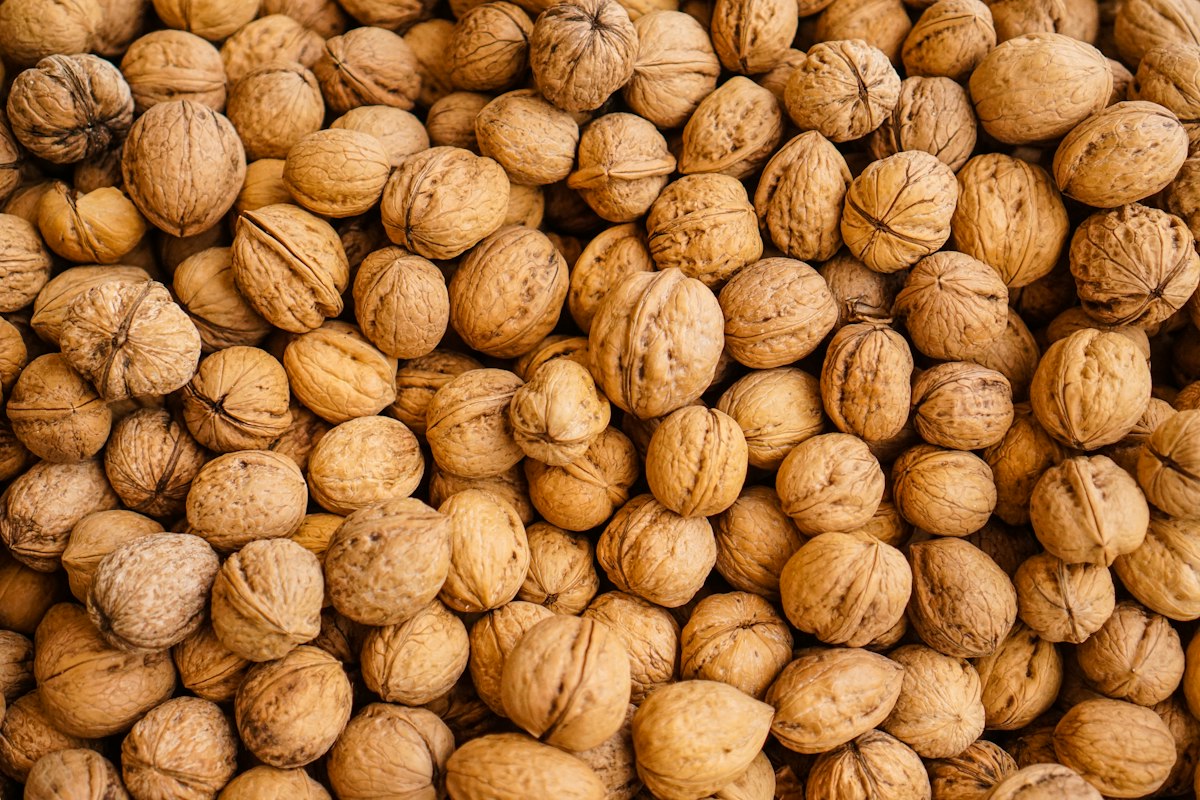
Among tree nuts, Juglans regia (English walnut) stands fundamentally apart owing to its non-standard lipid architecture and dense polyphenolic envelope. While most tree nuts (almonds, hazelnuts) are dominated by monounsaturated oleic acid (18:1 n-9), walnuts allocate approximately 65% to 70% of total biomass to polyunsaturated fatty acids (PUFA), establishing themselves as the preeminent terrestrial reservoir of plant-derived alpha-linolenic acid (ALA, 18:3 n-3). Food engineers approach the walnut kernel as a delicate thermodynamic compromise between hyper-unsaturated lipid fragility and dense protective ellagitannin shielding.
1. Introduction: Walnut Lipid Architecture and Alpha-Linolenic Acid Foundations
Walnut oil supplies 10% to 14% essential omega-3 ALA. Intracellularly, ALA undergoes hepatic microsomal elongation and desaturation governed sequentially by Δ6-desaturase, elongase-5, and Δ5-desaturase into eicosapentaenoic acid (EPA, 20:5 n-3) and docosahexaenoic acid (DHA, 22:6 n-3). Because these enzymes are shared competitively with omega-6 linoleic acid (LA, 18:2 n-6), maintaining a balanced dietary omega-6 to omega-3 ratio (sim 4:1) selectively favors resolving, anti-inflammatory series-3 prostaglandins and protectins.
2. Technical Analysis: Desaturase Kinetics, Ellagitannin Bioconversion, and Case Studies
The cardiovascular protection of walnuts is not mediated solely by essential fatty acids. The thin brown pellicle surrounding the kernel concentrates massive quantities of hydrolyzable ellagitannins (pedunculagin and tellimagrandin). Following gastric transit, colonic anaerobes hydrolyze these oligomers into ellagic acid, further metabolizing them into bioavailable, anti-atherogenic Urolithin A.
Lipid Auto-Oxidation and Storage Thermodynamics: The bis-allylic methylene carbons (-CH=CH-CH_2-CH=CH-) characteristic of polyunsaturated fatty acids possess weak carbon-hydrogen bond dissociation energies (sim 322 kJ/mol), rendering them exceptionally susceptible to free radical abstraction by ground-state triplet oxygen. At ambient temperatures under fluorescent retail lighting, peroxide values (PV) rapidly surge beyond the 10 meq O₂ /kg sensory rejection threshold, forming volatile off-flavor hexanals (oxidative rancidity). Engineering protocol: Shelled walnuts must be preserved in hermetically sealed oxygen-barrier barrier packaging at 0-4°C; high-heat commercial roasting should be rejected in favor of raw or mild dehydration regimes.
| Lipid / Chemical Parameter | Walnut Kernel Matrix | Almond / Hazelnut Matrix | Food Engineering Consequence |
|---|---|---|---|
| Total Lipid Mass (%) | 65% – 70% | 50% – 60% | High caloric density, lipophilic carrier matrix |
| Alpha-Linolenic Acid (ALA n-3) | 9% – 14% (Exceptionally High) | < 0.5% (Negligible) | Essential anti-inflammatory PUFA precursor |
| Monounsaturated Lipids (Oleic) | 14% – 18% | 65% – 75% (Dominant) | Thermodynamic baseline of oxidation resistance |
| Critical Peroxide Threshold | > 5 meq O₂ /kg (Onset of rancidity) | > 10 meq O₂ /kg | Mandatory dark, chilled refrigerated storage |
3. Conclusion: Engineering Takeaways, Oxidative Stability, and Storage Protocols
Walnuts supply concentrated clinical neuroprotective and vascular benefits. European Food Safety Authority (EFSA) health claims validate that daily consumption of 30 g of walnuts improves endothelium-dependent vasodilation. Critical consumer rules: (1) Procure walnuts in-shell or transfer shelled kernels immediately to airtight refrigerated containers; (2) Reject kernels exhibiting rancid odors (oxidized PUFA generates cytotoxic peroxides); (3) Never remove the astringent brown exterior pellicle, as it harbors over 90% of total radical-scavenging ellagitannins.