
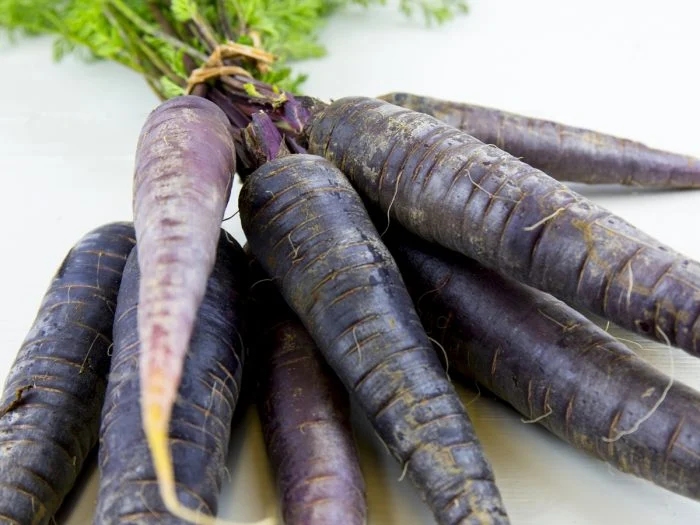
As global consumer demand converges toward clean-label formulation and natural food colorants, Daucus carota L. ssp. sativus var. atrorubens (black/purple carrot) emerges as an exceptional industrial biomaterial. Cultivated across the Mediterranean basin and traditionally utilized in Anatolia as the primary substrate for fermented shalgam beverages, black carrot represents far more than an intense chromophore reservoir; its unique acylated anthocyanin architecture imparts extraordinary thermal, photochemical, and hydrolytic stability within food processing operations.
1. Introduction: Black Carrot Matrix and Acylated Anthocyanin Chemistry
Anthocyanins in soft fruits (e.g., strawberry or cherry) exist primarily as non-acylated monoglycosides, undergoing rapid nucleophilic water attack at position 2 to form colorless hemiketals and chalcones upon heating or pH elevation. Black carrot anthocyanins diverge structurally: the cyanidin aglycone is esterified to hydroxycinnamic acids, predominantly sinapic, ferulic, and p-coumaric acids. This acyl domain participates in intramolecular hydrophobic stacking (copigmentation), sterically shielding the flavylium cation core against hydration and thermal decomposition.
2. Technical Analysis: Thermal Degradation Kinetics, pH Buffering, and Fermentation Engineering
The thermal degradation of black carrot pigments conforms to first-order reaction kinetics: ln(C_t / C₀) = -k · t, where C₀ represents initial pigment loading, C_t denotes residual concentration after exposure duration t, and k represents the temperature-dependent kinetic rate constant. The Arrhenius activation energy (E_a) calculated for acylated black carrot pigments spans 70 to 85 kJ/mol, significantly surpassing the 50 to 55 kJ/mol thresholds observed in typical berry extracts.
Industrial Fermentation Case Study (Shalgam Processing): In traditional fermented turnip-carrot processing, black carrot batons undergo solid-state sourdough lactic acid fermentation. Inoculation with Lactobacillus plantarum and L. brevis metabolizes fermentable hexoses, depressing matrix pH to 3.3 – 3.6. This acidic environment structurally preserves the cyanidin chromophore in its intense red flavylium cation state. Upon subsequent high-temperature short-time (HTST) pasteurization (85°C for 15 seconds), total anthocyanin degradation remains below 5%, ensuring commercial shelf stability without synthetic coal-tar colorants (e.g., Allura Red AC, FD&C Red No. 40).
| Kinetic Parameter / Condition | Acylated Cyanidin (Black Carrot) | Monoglycosidic Cyanidin (e.g., Blackberry) | Technological / Health Implication |
|---|---|---|---|
| Thermal Half-Life (t_½ at 80°C) | ~8.5 – 11.2 hours | ~2.1 – 3.4 hours | High stability during industrial thermal processing |
| Effective pH Window | pH 1.0 – 5.5 (Broad spectrum) | pH 1.0 – 3.0 (Narrow acidic window) | Versatility in dairy and neutral beverage applications |
| Activation Energy (E_a) | 78.4 kJ/mol | 52.1 kJ/mol | Enhanced barrier against thermal degradation spikes |
| Colonic Bioaccessibility | Microbially transformed into phenolic acids | Rapid proximal glycosidic cleavage | Extended systemic gut antioxidant coverage |
3. Conclusion: Engineering Takeaways and Clean-Label Formulation
From a food engineering perspective, black carrot extract represents the gold standard natural alternative to synthetic azo dyes. To maximize processing yields: (1) Thermal extraction should be restricted below 55°C coupled with vacuum concentration; (2) Formulation pH should be maintained near 3.5; (3) Naturally fermented functional matrices (such as shalgam) warrant expansion due to their simultaneous delivery of viable lactic acid metabolites and acylated anthocyanin complexes.